Unreal Bird #10: Audience

I spent most of last week at an AI and Journalism conference in Baltimore; serendipitously, my latest piece for Tech Policy Press, an interactive timeline covering the transatlantic far right, started as a Claude Code experiment.
Thanks for reading Unreal Birds, a newsletter about how tech, media, and capital undermine democratic accountability. Forwarded this newsletter? Consider subscribing.
Keen readers will notice I played with the newsletter format this week. But never fear: You can still scroll to the bottom to see dogs!
What I'm up to
I have two new pieces. One, on gaming trust & safety, I will save for next issue. Instead I'll focus on the other, an interactive timeline for Tech Policy Press illustrating the deepening relationship between the Trump administration, the European far right, and Silicon Valley.
This is a coalition composed of differently motivated camps. Some parts of the Trump administration want Europe to dial back its digital regulations against hate speech and election disinformation in order to boost fellow right-wing ideologues among Europe's far right. Others are nationalists who see constraints on US tech companies as constraints on US power. Some tech industry players just want to wriggle out of regulatory obligations, but others (like Elon Musk) also have right-wing sympathies. Europe's right wants to roll back digital hate speech rules, emulate Trump's political success, and potentially secure State Department funding while avoiding close public associations with a US president who is deeply unpopular in Europe. The members of this coalition have wrapped their efforts in rhetoric about free speech and censorship. The full piece is here.
I am focusing on this piece because it's relevant to the conference I just attended in Baltimore: I created the timeline with assistance from Anthropic's Claude, including some work in Claude Code. I learned a lot in the process about the benefits and pitfalls of using AI for journalism.
My first step was to feed Claude examples of press coverage about my chosen topic, then ask it to find more coverage and organize key events into a spreadsheet. Next, I used Claude Code to transform that spreadsheet into the interactive web feature that is the spine of my recent piece. This approach was later validated by the title of a talk at the Hacks/Hackers conference, "Spreadsheets not Chatbots."
The below slide from that talk does a great job encapsulating this approach. The chat interface through which most people use LLMs obscures different roles an LLM can play. The user interface (UI) is most intuitive but the least dependable; in the words of this presenter (ProPublica's Aaron Brezel), AI chatbots function as a sort of claw machine and there is no way of knowing exactly what it will grab.
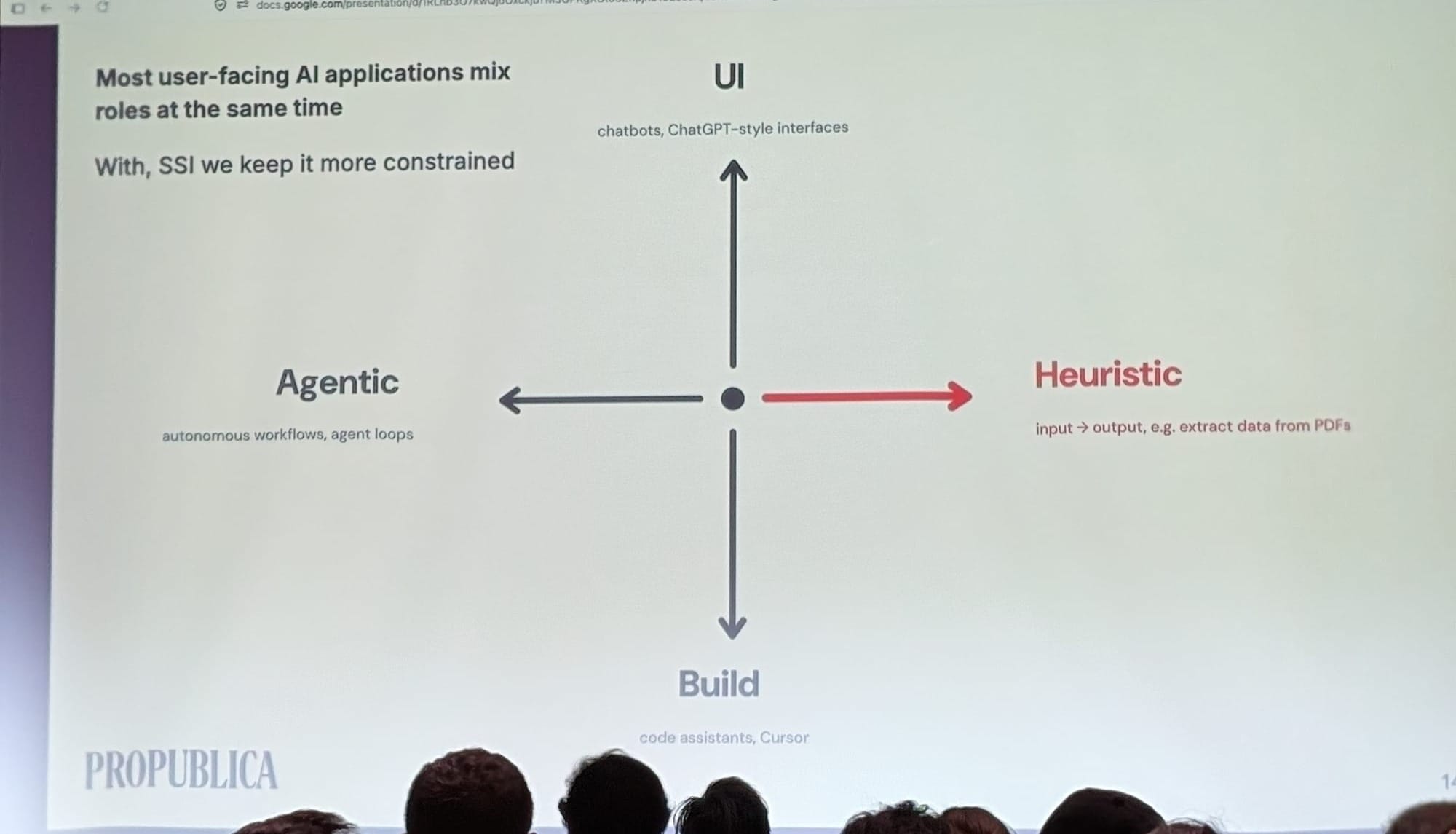
However, AI tools are much more reliable for building things in code. They're not perfect, but they're better than someone like me whose HTML skills peaked while customizing Myspace pages in 2005. Giving the LLM structured content via spreadsheet then asking it to output a web feature reduces its unreliable, claw-machine-like behavior. For a freelance journalist or a small outlet, the ability to create web features quickly from structured datasets feels genuinely transformative.
The allure is obvious, but as I mentioned above, there are also pitfalls. In retrospect I wish I'd have hand-coded the spreadsheet myself. Claude didn't make stuff up, but it struggled to match events and quotations to the exact hyperlinked citations they came from. This made the fact-checking process extra laborious; it was more time-consuming to triple-check Claude's work than to do a proper job myself.
One more process note: the piece also contains a set of nine documents, mostly European parliamentary statements and questions signed by members of the European Parliament critical of Europe's digital regulations. I probably would not have found these without Claude, because it didn't occur to me to search the European Parliament's Public Register.
My intent was to make a dashboard showing the countries and political affiliations of the signatories, so I had Claude create a spreadsheet with that information. But when I went to double-check the spreadsheet, I found Claude had included a number of unrelated materials. I asked why, and Claude responded that it stopped reading the content of the statements upon observing that many had the same signatories—acting as if every document signed by that group was relevant to my research.
The final version contains only documents determined to be relevant by human reviewers, including myself.
Audience
I have a lot of other thoughts from the conference, but I'm already running low on space for this issue. Maybe I will write them up in their own essay.
I do want to offer up an uber-question which hung over the whole affair: Why? Some journalists feel pressure (from investors, from management, from THE MARKET) to shove AI into every applicable interface. But in practice, does anything about the AI boom help outlets better connect to, serve, or expand their audiences?
In the case above, I wanted to present previously reported trends in a format that might hit readers a bit differently; some people need a visual to truly grasp a concept, and I didn't have the technical skills to create a compelling graphic on my own. Not every tool or use case has such a clear value add, as I learned through my AI-assisted research challenges.
The Baltimore conference had a whiff of existential dread in the air. AI optimists bemoaned short-sighted editors who were failing to transform newsrooms while skeptics feared negative disruption from overenthusiastic executives. Many of the participants no doubt possess traumatic memories of previous closures and layoffs across the media industry. I learned a lot and made some great connections, but in some ways it felt like a raft full of shipwreck survivors.
Something new is in the air, something different from the decades-long handwringing about the decline of journalism. During one conversation, I was reminded of the collapsing web traffic of right-wing sites like The Daily Wire or Breitbart. Before you applaud, Truth Social is way up, mainstream media's numbers declined slightly, and Bluesky engagement is way down.
When I asked, naively, "where has all the traffic gone?" someone deadpanned: "The chatbots."
I suspect this is one of several correct answers. TikTok use seems to be holding up, so maybe eyeballs are continuing to shift toward video and influencer-based content. Or maybe the national mood, so low it feels like we have fallen into the Mariana Trench, is driving news avoidance.
Whatever the combination of factors, the results worry me. Literacy as an increasingly niche phenomenon; a media landscape filled with billionaire-backed sycophants and sockpuppets; a return to pre-Enlightenment sensemaking; these are signs we're headed somewhere bleak.
Field notes
Three interesting pieces on how the tech industry is shoveling money into the midterms:
"Andreessen Horowitz Is Spending on Politics Like No Other," Teddy Schleifer, The New York Times.
- Venture capital firm Andreessen Horowitz is the midterm cycle's biggest donor so far with $115.5 million in disclosed contributions—more than George Soros or Elon Musk. The contributions are split between Fairshake (crypto-focused) and Leading the Future (focused on AI deregulation).
"AI Safety PACs Should Be More Transparent About Who's Funding Them," Veronica Irwin, Transformer.
- Public First Action, an AI-focused 501(c)(4), lists "Accountability and Transparency" as its top AI policy priority while funneling $5.5 million through a dark money structure that doesn't disclose donors.
"An Oregon Congresswoman Distanced Herself from Leading the Future — Then Backtracked," also from Veronica Irwin, Transformer.
- Candidates for public office are walking a tightrope between campaign donations from AI Super PACs and citizen techlash. One told Transformer she didn't seek an endorsement from Leading the Future, only to seemingly reverse course hours later.
Snoot watch

Humble plea
This newsletter is mostly powered by caffeine. If you've made it this far, consider buying me a coffee at the link below:
